Artificial Intelligence is everywhere right now and for good reason. It’s fast, efficient and increasingly capable. But it’s not all good news.
There are increasing numbers of stories and reports about future job cuts due to AI automation. Goldman Sachs predicts that 300 million jobs will be lost or degraded due to AI. Microsoft, Atlassian and Canva have recently been in the news for replacing staff with AI.
Closer to home, the Commonwealth Bank axed 45 jobs due to AI (although it later reversed its decision). More broadly, a recent report from Jobs and Skills Australia found that 13 per cent of jobs could be automated by 2050, with more than half augmented by AI.
At the top of the hit list are many entry-level roles, along with jobs in data entry, record keeping and accounting most at risk of automation. While engineering is some way down the list, it is still likely to be affected, so for professionals such as Systems Engineers the big question is – will AI make me redundant?
The answer: no and here is why…
AI is a tool, not a human replacement
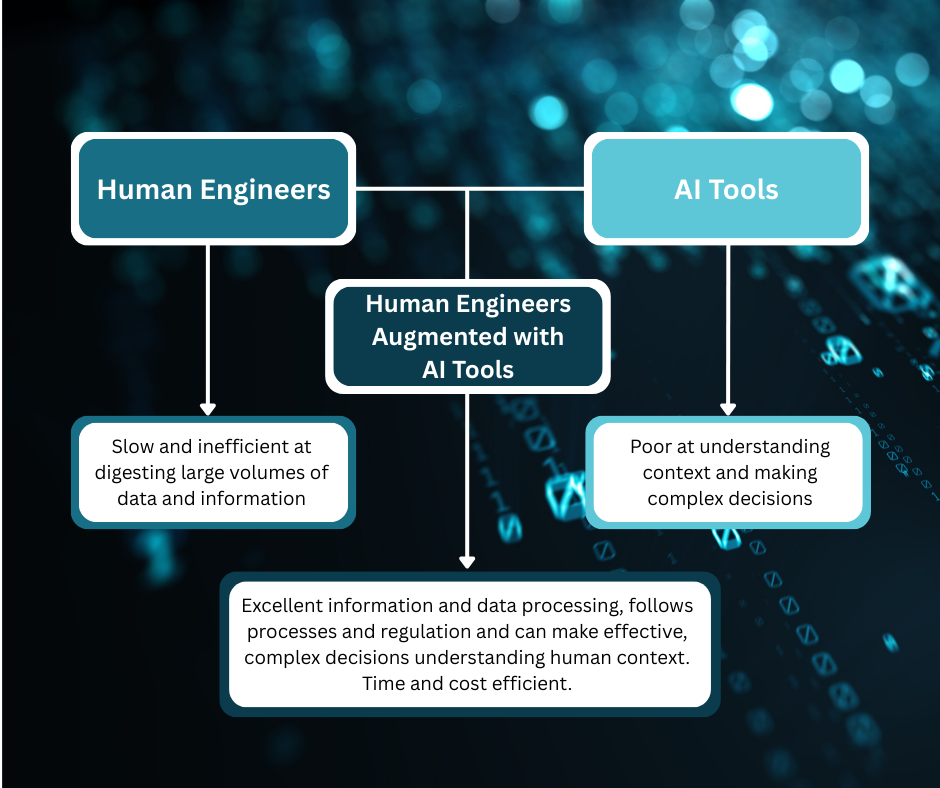
AI has some amazing abilities, and when used correctly can be a hugely powerful tool. This might be concerning to people who don’t have a good understanding of its capabilities creating the fear that AI is becoming so powerful it will directly replace them in the near future. While AI might make it possible to automate some tasks associated with systems engineering, I would argue that you will always need a human in the loop.
What AI excels at
AI can automate repetitive, time-consuming tasks such as:
- Drafting documentation
- Summarising long technical reports
- Extracting relevant clauses from standards
- Organising hazard logs or traceability matrices
If your job and skills are only in these areas and you are not willing to upskill or adapt, then yes, you should probably be worried. However, the use of this technology is not about removing people, it’s about removing repetitive and potentially mundane tasks from the everyday workload and creating efficiencies. Most of these tasks still need human oversight, subject matter expertise and reasoning, none of which AI can replicate well at the moment.
Where AI struggles
AI is generally poor at understanding context without a significant amount of specific training and manual input. It relies on its training data to make informed decisions, and each project has different challenges and nuances often caused by unpredictable human influences such as political or local effects which may not translate well to its trained data. This makes it difficult for the AI to comprehend how a specific human factors risk could manifest in a real-world rail environment, for example it might struggle to navigate stakeholder complexity or apply sound judgment in safety-critical decisions. This is where human engineers remain essential.
The more advanced (bigger/better trained) the AI, the better it will be at navigating these decisions, but this comes with the price of greater cost especially if hosting your own private AI for data and IP protection, which may diminish any value it delivers in terms of saved man hours Another barrier to its widescale adoption is linked to the time, cost and effort in training and deploying models. And then there is the issue of cybersecurity. Many companies will have sensitive information that could be at risk if they used it to train an AI model.
Systems engineers leveraging AI = Better, faster outcomes
How often do you feel that you could do with more time on projects that you have worked on? How often do you find yourself prioritising tasks based on importance as you don’t have time for them all? How many of your projects have you had to ask for deadline extensions due to overoptimistic deadlines or unexpected changes?
When used effectively and responsibly, AI can help us:
- Reduce manual admin and repetitive automatable tasks
- Find and/or decompose relevant data very quickly
- Reduce human error
- Enable engineers to focus more time on complex problem-solving
- Deliver projects more efficiently (cost and time)
- Free up time for deeper analysis on critical areas such as safety and stakeholder engagement.
This leads to better outcomes for our projects, without sacrificing rigour or safety.
Acmena’s experience with AI
Acmena has been conducting in-house experiments using AI and Large Language Models (LLMS) to streamline systems engineering and assurance processes, with the objectives being:
- To explore the possibility of creating a tool that would improve documentation drafting efficiency.
- To assess the potential for the tool to analyse large volumes of unstructured requirements and verification and validation (V&V) data.
- Develop a codebase that allows easy access and standardization for deployment into projects, including a standard set of code and techniques for specific functionalities used by teams.
- Explore the possibility for the tool to perform human-like analysis of unstructured documentation.
So far, most of the objectives have been successfully achieved, and from the results of our research we have concluded that the benefits and improvements in productivity are already tangible. Using AI to complete laborious tasks creates more time to focus on safety analysis and is likely to improve our level of service. In the case of Acmena, it translates to better outcomes from systems engineering and system safety assurance for clients and infrastructure projects.
However, the technology cannot be trusted on its own. It still lacks the capacity to articulate complex, unrelated, multi-step logic, and it is exposed to hallucinations, especially when unstructured input data and instructions are provided. In other words, you still need a human in the loop.
Don’t get left behind
AI will undoubtedly be used in future projects to reduce many required man hours on automatable tasks, this shouldn’t have you worried about being made redundant as long as you are willing to upskill and adapt.
Safety critical decision making, stakeholder management and management and review of these AI driven tasks will be still required and can be better focused on by systems engineers.
What is likely to happen is that the tasks you are performing now will likely change and as long as you are willing to learn how to use these AI tools and develop skills such as effective prompt engineering to utilize the full potential of these emerging technologies, you are likely to still have a job as a systems engineer.
AI is our friend, not our enemy
By setting up effective AI usage process and policies while creating and embracing the right tools with data security always in mind, we can spend less time repeating ourselves and more time doing what we do best, engineering safe, efficient and human-centred systems in a safe and secure manner.
What do you think?
Are you already using AI to lighten the load, or are you still exploring how it fits into your workflow? We’d love to hear your thoughts in the comments section of our LinkedIn page.
Staff Profile: Matthew Manger | Systems Engineering Consultant
Related Content: The Role of AI and LLMs in Systems Engineering & Safety Assurance